



The short version
- Commission work around a specific reader decision, with evidence and acceptance criteria agreed before drafting.
- Plan capacity around research, expert review and publication, then track where work actually waits.
- Measure whether content serves its intended purpose and feed corrections back into the next brief.
Find the constraint before commissioning more content
To scale content without lowering the standard, make research, review and publishing repeatable before increasing assignments. A writer needs a defined reader question, usable evidence and a reviewer who can make a decision. A publisher needs approved copy and complete assets. If those inputs arrive unpredictably, a fuller calendar gives the team more unfinished work.
Start with the last few pieces your team attempted, including anything still waiting for approval. Record when each entered briefing, research, drafting, review and publication. Separate time spent working from time spent waiting. A draft that took two days to write and nine days to receive feedback has a different problem from a draft that needed three structural rewrites.
These are diagnostic questions for your own operation, not claims about how every marketing team works. Ask what prevented the next handoff. Was the angle unresolved? Did an expert receive a document without knowing what to check? Did nobody own the final decision? Choose the most consequential recurring blockage and change that part of the process first.
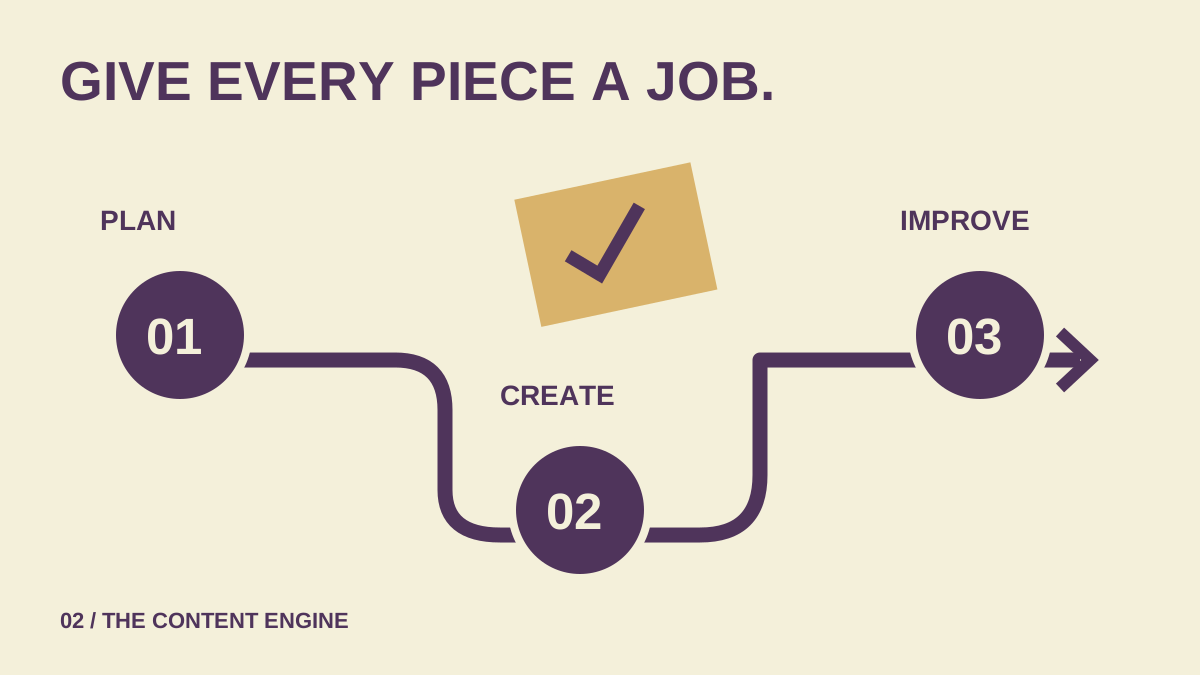
We use Content Engine to describe the ongoing work that turns editorial direction into researched, reviewed and maintained content. The engine includes the decisions around production. A calendar remains useful, but its dates should reflect those dependencies.
| What you observe | What to investigate |
|---|---|
| Several rewrites before expert review | Whether the brief settled the reader, angle and evidence. |
| Drafts wait with the same reviewer | Review capacity, responsibility and escalation. |
| Approved work stays unpublished | Missing assets, CMS ownership or release requirements. |
| Plenty of articles, few useful sales links | Whether assignments address questions buyers actually ask. |
Give each assignment a reader decision
“We need an article about onboarding” leaves the useful part undecided. An operations lead comparing suppliers needs different information from an administrator setting up a purchased product. Choose the situation before choosing the format. Then write the decision the reader should be better equipped to make after using the content.
GOV.UK’s guidance on user needs starts with people’s tasks and supporting evidence, and recommends acceptance criteria that describe when the need has been met. That is a useful planning discipline for commercial content too. Its application here is our editorial recommendation, rather than evidence that following a government publishing method improves B2B conversion. GOV.UK: identify user needs and acceptance criteria
For an illustrative software business, an assignment could help an operations lead check whether a proposed migration schedule accounts for their data cleanup work. Evidence might include current import requirements, a product specialist’s explanation and permissioned customer questions. A general interview remark is a lead to investigate, not proof that every buyer faces the same obstacle.
Test whether the proposed answer already exists. If a current guide answers most of the question, updating it may serve the reader better than creating a second overlapping page. If two audiences need different decisions, separate the scope deliberately and link the pages. Give each question a clear home so future writers can see what to extend and what to avoid repeating.
Make the brief specific enough to reject a weak draft
A useful brief lets an editor explain why a draft does or does not meet the assignment. “Make it insightful” cannot do that. For the migration example, the draft should distinguish supplier setup time from work the customer must complete, identify the required inputs and explain which unknowns prevent a credible schedule.
Attach the relevant reference material rather than asking the writer to reconstruct the business from its homepage. A Brand Brain can supply approved product facts, audience context, voice examples and known limits. The brief still needs fresh research for the particular question. A shared reference does not make an old claim permanently current.
List the central claims that need evidence and the person who can resolve gaps. Include a current source for product behaviour; label a worked example as illustrative; obtain permission before quoting a customer. Where evidence is missing, choose between further research, narrower wording or removing the claim. A deadline is not evidence.
Google’s people-first content guidance asks whether material offers original information or analysis, clear sourcing and enough substance to help readers achieve their goal. Use those questions when reviewing the actual draft. Neither a word target nor the presence of references proves that an article is helpful. Google Search Central: helpful, reliable, people-first content
| Brief field | Illustrative migration assignment |
|---|---|
| Reader and decision | Operations lead checking whether the proposed schedule is realistic. |
| Required answer | Which customer tasks must be complete before migration can start? |
| Evidence | Current import documentation and a recorded specialist explanation. |
| Acceptance criteria | Names the inputs, dependencies, exceptions and questions still to resolve. |
| Boundary | No universal implementation timeline or invented customer saving. |
| Next useful step | Prepare the required inputs for a scoping conversation. |
Give reviewers a decision, not a blank document
Before drafting starts, name the editor, specialist reviewer and publication owner. One person may cover more than one role in a small team. What matters is knowing who checks the argument, who confirms factual accuracy and who can approve release. Ask about availability before attaching their name to a date.
A review request should identify the decisions needed. For a specialist, that might mean confirming three product behaviours and resolving a disputed exception. For an editor, it might mean checking whether a reader can distinguish mandatory preparation from optional advice. Targeted questions make the required work visible and help prevent a factual review becoming an open-ended rewrite.
The Department for Education’s account of its content workflows recommends agreeing roles, feedback and sign-off tracking, authority when disagreements arise and cover when someone is unavailable. Those are useful process questions, but its published production timings describe its own services. Do not turn them into a universal article schedule. Department for Education: content workflow tips
Set a review deadline that the reviewer accepts. If it slips, the owner should reschedule, find a qualified substitute or narrow the scope. Silence should not become approval for an unverified claim. If new evidence changes the substance, return the affected section to review and record the final decision in one place.
| Decision | Responsible role | Ready to move when |
|---|---|---|
| Does it answer the brief? | Editor | Scope, structure and reader usefulness are accepted. |
| Are specialist claims defensible? | Subject expert | Questions are resolved or limits are explicit. |
| Can this version go live? | Publication owner | Approved version and release checks match. |
Plan the work your team can finish
Build the next production cycle from the capacity of the whole team. If a specialist can review two substantial drafts, commissioning six that require their approval creates an obvious queue. That hypothetical example is simple arithmetic, not a recommended two-article limit. The right volume depends on the work, its risk and the people available.
Use distinct states that expose the next action: approved brief, research underway, drafting, editorial review, specialist review, ready to publish and published. Add an owner and the date the piece entered its current state. “In progress” is too broad to tell you whether anyone is working or whether the team needs a decision.
Keep blocked work visible with a reason and a named person who can unblock it. During planning, review old blocked items before starting new ones. An article awaiting a product decision may need to pause; a correction to a live page may need priority. Reserve room for these obligations rather than committing every available hour to new production.
GOV.UK’s documented mainstream publishing process separates triage, drafting, independent editorial review and, when necessary, specialist fact checking. You do not need to reproduce its organisation. The useful operational distinction is that writing a draft and approving a factual change are separate decisions. Your board should make those decisions visible. GOV.UK: mainstream content publishing process
Use AI where the output can be checked
AI can help organise an approved source pack, suggest an outline or flag inconsistent terminology. Define the input, the permitted task and the check before using it. For example, asking for a list of claims and their supplied sources creates something an editor can inspect. Asking for an authoritative article without a verified evidence base leaves the most important work unresolved.
Check the underlying source, not just the generated citation. Does the document exist? Does it support this exact claim? Is the product version, country or date relevant? A genuine source can still be misapplied. Run this check on numerical claims, comparisons, quotations and consequential instructions even when the prose sounds convincing.
Google’s guidance on generative AI warns that producing many pages without added value may violate its policy on scaled content abuse. It also asks publishers to focus on accuracy, quality and relevance. The editorial implication is to assess the finished work and its contribution, not treat either AI use or a human byline as a quality certificate. Google Search Central: guidance on generative AI content
If faster drafting simply sends more weak work to the same reviewer, the process has moved the burden. Track which AI-assisted tasks save verifiable effort and which create corrections. Keep responsibility for the published version with the team, and record consequential corrections in the reference material so the next assignment does not repeat them.
Treat publication as part of the assignment
A reviewed document still needs a usable page. Include the title and description, correct links, image rights and alternatives, heading structure, language version and publication owner in the handoff. Preview the actual page on mobile. A table that worked in a document can become unreadable in the CMS, and a descriptive heading can lose its meaning when the template changes its hierarchy.
W3C’s writing guidance recommends informative titles, meaningful headings and link text, appropriate image alternatives and clear instructions. These are practical content checks that support accessibility. They do not replace testing the complete interface, including keyboard operation and assistive technology. W3C WAI: writing for web accessibility
Our TVProperty programme illustrates why the release package matters. The work included a 90-publication audit, audience and voice references, topic ownership decisions, and a developer publishing checklist. These support an ongoing plan of eight articles per month across four websites, with the long-term aim of strengthening domain authority across the portfolio. That commitment is distinct from a claim of measured traffic or authority gains.
The transferable decision is to prepare content and publishing requirements together. Language counterparts, source links and image files need predictable ownership and naming before volume grows. Otherwise, the publisher has to repair the package one article at a time, while the next batch is already arriving.
Measure the job the article was commissioned to do
Record the intended outcome before release. An article helping buyers prepare for a scoping call needs different evidence of usefulness from a troubleshooting guide. Keep operational measures, such as waiting time and revision rounds, separate from audience and business measures. A smoother process is valuable, but does not prove the content influenced a sale.
Google Analytics describes key events as recorded actions important to the business. Decide which actions actually matter before marking events as important. For the migration example, a completed relevant enquiry may be worth tracking; a page view alone does not show that the reader understood the preparation work. Google Analytics: about key events
Combine the numbers with specific feedback. Ask sales whether prospects arrive with the necessary information, and ask readers what remains unclear. If search traffic is relevant to the assignment, use Search Console to examine queries, pages, impressions and clicks. Its reporting describes search exposure and interaction, not whether an article caused a commercial outcome. Search Console: performance report
Assign a review date suited to how quickly the subject changes, plus triggers such as a product release or repeated support question. Decide what to retain, revise or retire. When performance changes, investigate measurement changes, distribution and seasonality before attributing the movement to a rewrite.
| Article purpose | Useful evidence | Insufficient on its own |
|---|---|---|
| Support a buying decision | Relevant enquiries and sales feedback on remaining objections. | Total visits. |
| Help someone complete a task | Task feedback and evidence of where instructions fail. | Time on page. |
| Answer a searched question | Relevant query visibility, clicks and reader feedback. | An isolated average position. |
Start with one complete production cycle
Choose one important reader question, check existing coverage and prepare the brief with its evidence. Book the review before setting the publication date. Take the piece through research, drafting, approval, release and follow-up, recording the places where the team had to guess or wait.
Use what happened to improve the next cycle. A repeated factual correction belongs in the Brand Brain. A late image requirement belongs in the publishing checklist. An unclear approval belongs in the responsibility agreement. Only increase the workload when the team can explain how the additional pieces will reach publication at the agreed standard.
- If you have a large backlog: separate useful assignments from ideas that still need evidence.
- If experts have little time: ask focused questions early and agree what they must approve.
- If quality varies: use the same acceptance criteria and evidence checks across contributors.
- If publishing is inconsistent: investigate the recurring blocked handoff before adding deadlines.