



Real landing-page project with three completed content adaptations based on a reconstructed ABM brief. Campaign activation and results are outside this case study.
The problem
One product presentation had to support different buying decisions
Laktos Bulgaria was the client for this project; Capri Sun is the product brand featured in the work. The existing landing page brought together the Bulgarian portfolio, brand background, shelf-ready packaging and distributor information. We used that material and the original HTML design to build three versions for different commercial conversations.
The reconstructed brief was to support priority supermarket chains, petrol and convenience chains, and hotel or resort groups. The challenge was relevance: the same product information needed to answer different questions in each channel.
A brand introduction establishes familiarity. A buying conversation needs to establish fit. The assignment was to connect the portfolio to the decisions a commercial contact would have to make: where the product could belong, how it would be supplied and what information was needed before taking the discussion further.
Our scope was the content and landing-page layer of that programme. We developed three working variants and supporting sales copy. The account-selection and activation sections below explain the proposed operating plan around those assets, rather than implying that a campaign has already run.
The opportunity
Make the same portfolio relevant to three commercial conversations
The existing presentation already contained useful product information and a working design. The opportunity was to reuse that foundation while making the opening argument and next step relevant to each channel.
For the reconstructed ABM brief, we chose supermarkets, petrol and convenience chains, and hotels or resorts. These provided three contexts to explore assortment, purchase occasions and guest service. A live programme would still require selected named accounts and validation of their specific requirements.
The research
Review the source material and identify missing commercial evidence
We began by separating the material into three groups. Product information included the six flavours, the 200 ml format and the packaging. Brand material included its history, recognition and international reach. Commercial information covered the Bulgarian distributor, the channels listed in the presentation and the invitation to make contact.
That separation helped us decide which information could answer a buying question and which information mainly supplied background. Shelf-ready packaging can support a discussion about store presentation. A worldwide sales figure supplies scale, but does not answer a buyer’s question about local demand, margin or the performance of an individual location.
The source also left gaps that a sales team would need to close: current availability, case quantities, minimum orders, prices, delivery terms and any account-specific requirements. We did not fill those gaps with persuasive-sounding promises. Instead, the revised contact sections ask for the context needed to develop an appropriate offer.
The resulting brief was to preserve the common product story while making the buyer’s own situation more visible at the beginning and end of the page. This kept the adaptation focused and avoided producing three disconnected interpretations of the same brand.
| Source material | Role in the adapted page | Boundary |
|---|---|---|
| Portfolio and packaging | Explain the product and its presentation | Confirm availability and commercial specifications |
| International brand evidence | Provide background and recognition | Do not imply local account performance |
| Distributor information | Identify the next commercial contact | Confirm service requirements with the distributor |
Start with the account’s decision.
We organised the concept around three account groups with different buying contexts. For a live one-to-few ABM programme, sales would select named organisations within those groups using commercial fit, service coverage, purchasing structure and relationship context.
The proposed buying roles also shape the content. A supermarket category buyer may need to involve replenishment teams. A convenience buyer may need input from store operations. A hotel purchasing contact may need to agree the offer with food and beverage teams. These are questions to validate with the account, rather than assumptions to present as research findings.
| Account group | Question the page supports |
|---|---|
| Supermarket chains | How does the range fit our assortment and shelf operations? |
| Petrol and convenience chains | Where does the format fit a quick-stop purchase? |
| Hotel and resort groups | Which guest occasions could it serve, and how would supply work? |
Define who belongs on the account list.
The three channels are starting clusters, not a target-account list. A live programme would select named businesses with the distributor and sales team. Relevant criteria would include a plausible fit with the product format, serviceable locations, a purchasing structure the team can navigate and a commercial opportunity worth pursuing.
We would then distinguish an accessible opportunity from an attractive logo. An existing relationship, a known range-review process or a confirmed need for additional product information can give sales a reason to act. A company’s size alone does not establish timing or interest.
Each selected account would need a short record: why it fits, which group it belongs to, the contact or buying role, what is known about its situation, the main unanswered question and the next action owner. Accounts that cannot be served or whose requirements do not fit the offer should be excluded before spending effort on personalised outreach.
This is the account-based part of the proposed programme. The shared pages provide efficient personalisation for groups with related needs. Account context still comes from the sales introduction and subsequent conversation.
Write for the decision and the people around it.
A landing page may arrive with one contact and be forwarded internally. We therefore considered both the primary commercial reader and the colleagues who could influence the decision. These role maps are planning hypotheses to confirm, not the result of completed buyer interviews.
For supermarket accounts, the range argument may begin with a category buyer but lead to questions from replenishment or store teams. For petrol and convenience networks, format and placement may need operational input. For hospitality groups, procurement and food and beverage teams may look at the same product through different service requirements.
The page does not attempt to settle every operational detail. It establishes enough context for a relevant discussion and helps the reader identify the missing information. That is why the CTAs invite a conversation about requirements rather than promising a rollout or asking for an immediate order.
| Group | Proposed primary reader | Questions for supporting roles |
|---|---|---|
| Supermarkets | Category or range buyer | Shelf presentation, stock handling and replenishment |
| Petrol / convenience | Retail or category buyer | Store format, placement and delivery constraints |
| Hotels / resorts | Purchasing or food and beverage contact | Service occasion, seasonal needs and supply requirements |
Implementation
Build three pages around distinct buying contexts
We kept the original colours, imagery, product portfolio, layout and interactions. The changes sit in the opening message, the channel-specific explanation and the invitation to contact the distributor. That gives each version a clear purpose while preserving a consistent brand experience.
The supermarket page opens with assortment and shelf fit. The convenience page starts with travelling families and the portable format. The hospitality page focuses on guest occasions and supply planning. Each contact section asks for the context needed to make the next discussion useful.
The shared source still contains global brand figures. Those remain source presentation material, not evidence that a particular Bulgarian account will achieve the same performance. The adaptations add no margin, sales-lift or distribution promises.
Range and shelf fit
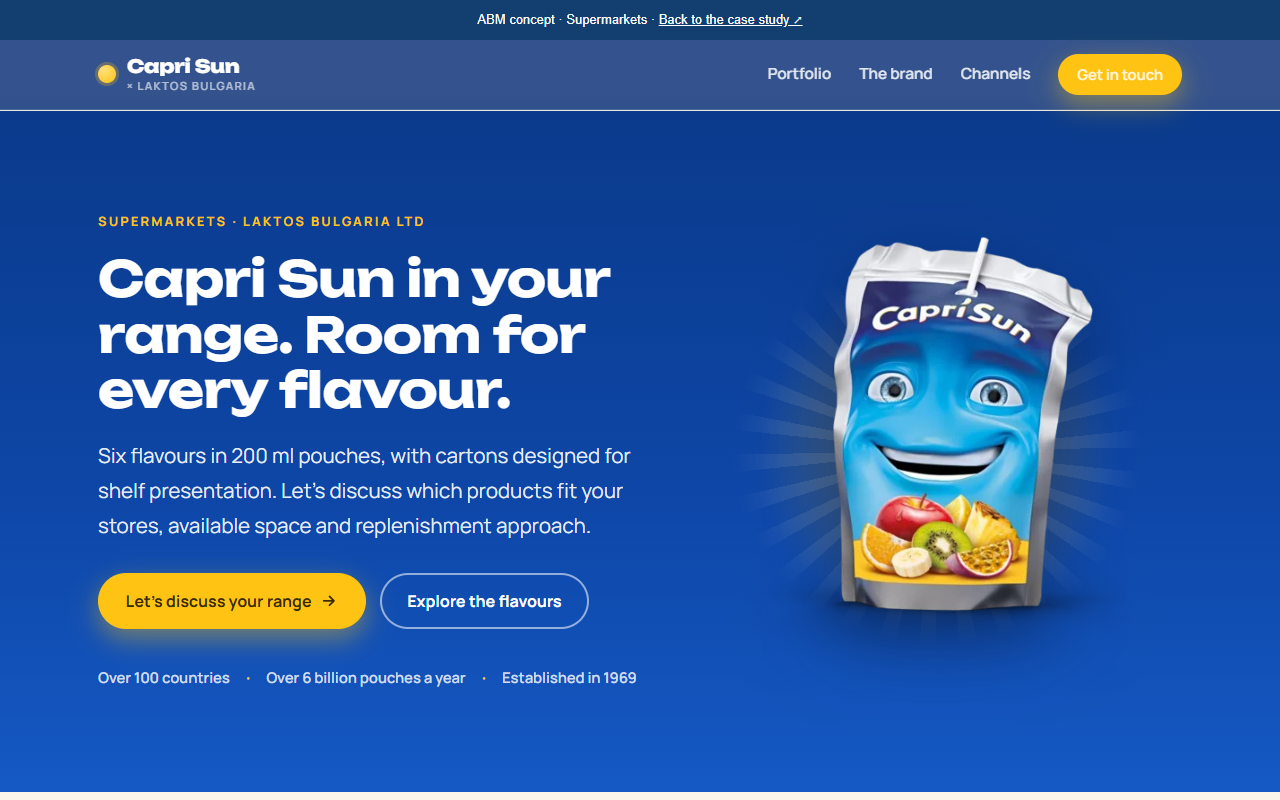
The opening moves to assortment. The channel section discusses shelf space and replenishment; the CTA asks for a range discussion.
Open full landing page ↗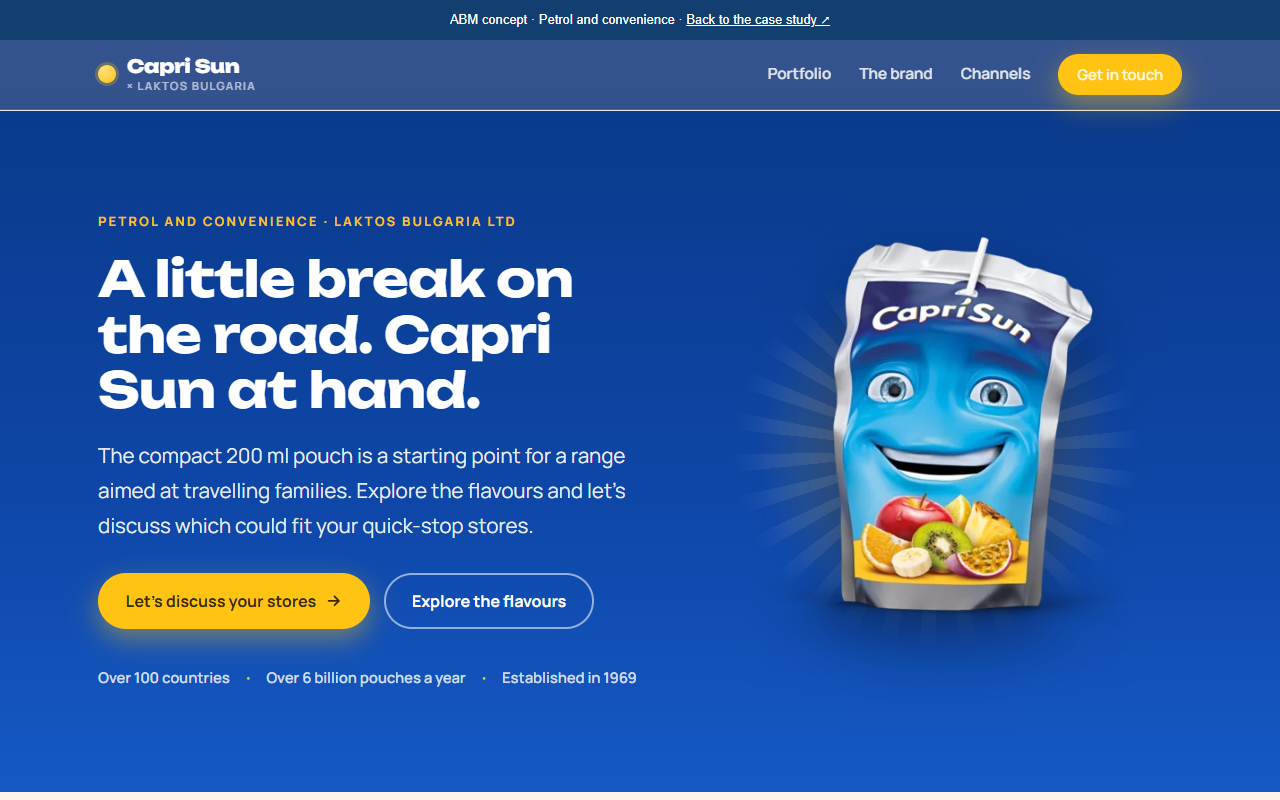
A quick-stop buying occasion
The opening centres on travelling families and the portable format. The CTA asks about store formats and merchandising needs.
Open full landing page ↗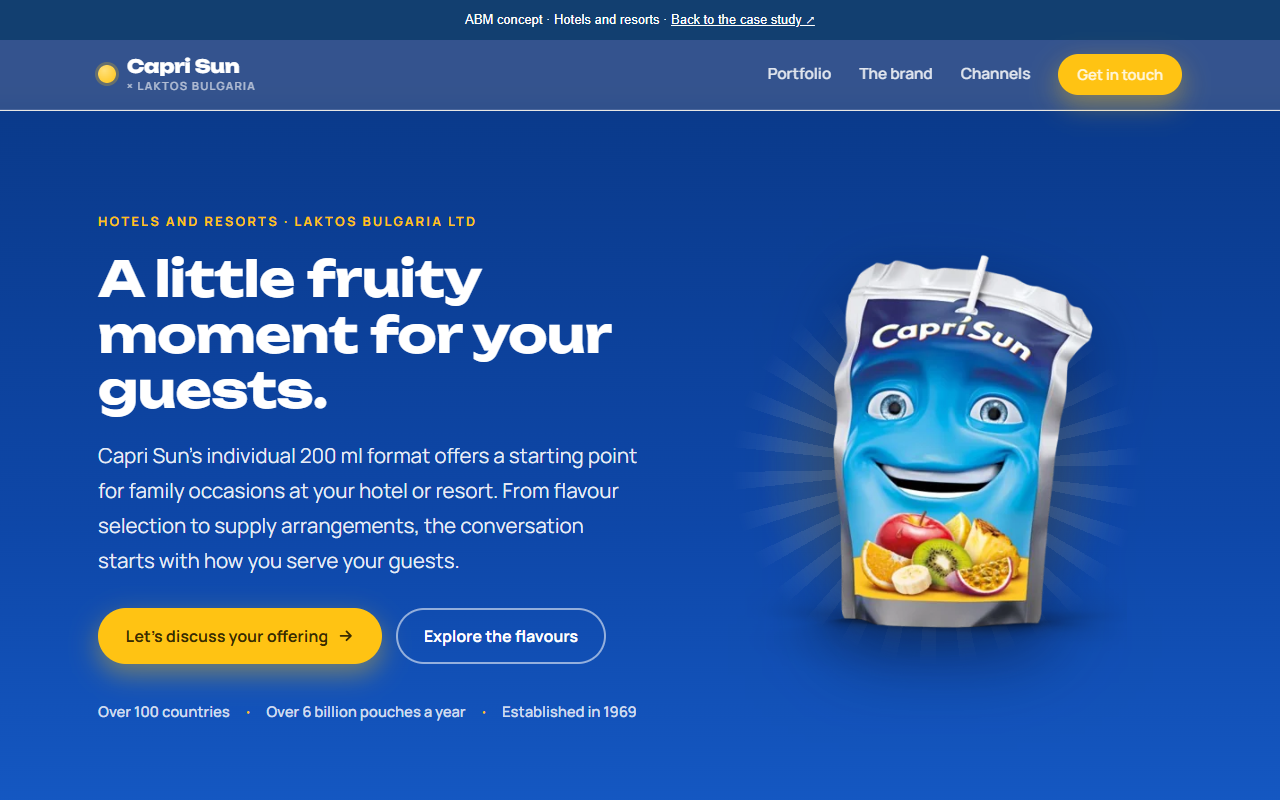
Guest occasions and supply
The opening addresses guest service. The channel section highlights seasonality and supply planning; the CTA asks about the property’s requirements.
Open full landing page ↗01 / Make the range discussion concrete.
The supermarket version opens with “Capri Sun in your range. Room for every flavour.” The emphasis is on assortment and flavour choice. The lead immediately connects the six-flavour portfolio and 200 ml format to the store’s available space and replenishment approach.
The channel section then narrows the broad source presentation to the practical shelf discussion. It explains that the choice of flavours should reflect the existing assortment and customers of the particular store. It asks about space, case formats, ordering conditions and delivery arrangements, with commercial details to be confirmed by the distributor.
The CTA, “Let’s discuss your range”, asks to discuss the assortment. It gives the buyer a clear subject for the conversation. We retained the full portfolio rather than implying that we had validated a best-selling subset for a specific retailer.
02 / Bring the purchase occasion forward.
The petrol and convenience version opens with “A little break on the road. Capri Sun at hand.” The idea is a short break on the journey, with the product close at hand. This shifts the opening from a general shelf listing to a proposed travel occasion.
The lead addresses travelling families and the compact format. The channel copy moves into store layout, visibility and replenishment questions. It does not claim that a particular placement will increase basket value or that the product is proven to outperform alternatives in these locations.
The CTA, “Let’s discuss your stores”, asks about the account’s outlets. That wording matters because a network can contain different store types. The first conversation should establish where the range could fit before making a network-wide recommendation.
03 / Connect the product to guest service.
The hospitality version opens with “A little fruity moment for your guests.” The emphasis moves from the retail shelf to the guest experience. The lead introduces individual portions as a starting point for discussing the property’s actual service model.
The channel section asks how the product might be offered, which flavours fit the concept and how seasonal requirements affect supply. It avoids prescribing a minibar, breakfast or children’s-service placement without knowing the property’s operations.
The closing invitation asks for the type of property, seasonality and intended way of serving the product. This creates a more useful first enquiry than a generic expression of interest: the distributor would receive context that can guide the assortment and supply discussion.
Personalise the message. Keep the experience coherent.
All three versions reuse the original HTML structure, colours, product imagery, portfolio and interactions. We changed the hero headline and lead, the explanation within the channel section, its channel labels and the closing contact copy. The pages remain recognisably part of the same presentation.
This was a deliberate scope decision. The product did not change between audiences. Rebuilding the visual language would add production work without resolving the main relevance problem. A common structure also makes it easier to compare the three messages and maintain shared product information.
The broader brand sections remain common across the variants. This is an initial messaging adaptation, not a claim that every paragraph has been personalised. Further account feedback could justify changing section order, adding specific commercial evidence or removing material that does not help a particular buying conversation.
The working pages were checked at mobile width for overflow and missing images. In this case study, the compact comparison allows readers to switch between the three versions with a keyboard and open each full page to inspect the implementation.
Proposed activation
Prepare sales introductions for each page
The proposed activation is straightforward: a salesperson selects the page that matches a target account’s buying context, introduces the relevant question and follows up on the account’s response. The page supports that conversation; it does not replace the account work.
These short introductions show how the page variants could be used. They are prepared examples, not messages sent to prospects.
Carry the same argument into outreach.
- Supermarkets
- Could Capri Sun fit your beverage range? Here is the portfolio and shelf-ready format. A useful next step would be to discuss your assortment and replenishment requirements.
- Convenience
- Would the 200 ml format suit the buying occasions at your sites? This overview focuses on the range and store-fit questions we could work through together.
- Hospitality
- Could Capri Sun have a place in your guest offering? This overview provides a starting point for discussing flavours, service occasions and your supply requirements.
Plan the handoff from interest to a commercial discussion.
The proposed sales sequence begins before the link is sent. The account owner confirms the reason for contact, chooses the relevant page and frames the introduction around a specific buying question. A warm contact and a new prospect would need different introductions even when they receive the same channel page.
Follow-up should respond to what the account says. A request for product details calls for a verified specification or availability response. Questions about service coverage need distributor input. Interest in a listing conversation needs a clear owner and a record of the account’s requirements.
We would record the account, recipient role, page variant, response and agreed next action in the sales record. A page visit alone should not trigger an assertion that the buyer is ready. The useful signal is the combination of account fit and a meaningful commercial response.
The distributor remains responsible for confirming commercial terms. The content asset introduces the offer and organises the conversation; it does not substitute for a quotation, supply agreement or operational commitment.
Measure account progress, not just page traffic.
A measurement plan should begin with a defined account list and observation period. Otherwise, increases in visits or responses can be caused simply by reaching more businesses. The account record also needs to distinguish an existing opportunity from one first opened through this activity.
The first layer is coverage: which selected accounts were reached and whether the relevant buying roles were involved. The second is engagement with substance: qualified replies, requests for useful information and accepted meetings. The third is commercial progression, such as moving into an assortment or listing discussion.
These measures are proposed for a future activation. We have no campaign dataset from which to calculate response rates, sales impact or return on investment. Comparisons between the three variants would also need to account for different account sizes, starting relationships and buying timelines.
| Stage | Evidence to record | What it can tell us |
|---|---|---|
| Coverage | Selected accounts contacted and relevant roles reached | Whether the planned audience was actually reached |
| Qualified engagement | Relevant replies, information requests and meetings | Whether the message opened a useful conversation |
| Commercial progression | Documented range or listing discussions | Whether accounts moved to a meaningful next stage |
| Business outcome | Confirmed agreements or orders, if they occur | Actual commercial outcomes, with attribution limits |
Results and next steps
Three completed adaptations, ready for account validation
The completed adaptation consists of three working landing pages built from one HTML design, with distinct selling points and contact copy. The comparison makes the content decisions visible, and each version can be opened in full.
For an activated campaign, the evaluation would follow selected accounts: relevant contacts reached, qualified replies, buyer meetings and progression into range or listing discussions. The time period, account list and evidence for each stage would need to be recorded. Traffic alone would not establish commercial impact.
No outreach, buyer interviews, listing agreements or campaign results are claimed here. The demonstrated work is the content adaptation and the sales assets prepared around it.